Thursday, October 9, 2014

Concerning Belugas: Captain Nemo still at it

12:28 PM
Beluga Webcam, courtesy of Vancouver Aquarium

Unfortunately, I haven't observed Nemo or Wake for a number of months, due to time constraints. It was only yesterday that I managed to spend some time observing the two of them.

I was curious to see whether or not Nemo (Aurora) was still exhibiting the "circuit swimming" behavior. I've come to believe this behavior isn't something that would happen in the mind, and is thus likely a compulsive disorder that has developed due to being held in captivity- however, I will research further into this theory. Unfortunately, the first thing I saw, was indeed, Nemo continuing with the circuit swimming- exactly as he was two months ago. I was, however, in for a surprise, when the two whales started to exhibit almost playful behavior (I will talk more about that in another post).

It is troubling to see that Nemo is still continuing with this circuit swimming: it has been going on for a minimum of three months, since I first started watching them. This behavior has evidently become a habit- maybe even a coping mechanism.

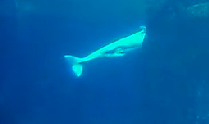
Here we can see the first leg of Nemo's journey: I can recognize it as Nemo, because of his very distinct raised formations on his underside (that look like a figure of eight when looked at straight on).


The second part of his journey can be seen here again, as he starts to turn around the boulder in the far end of the tank. Again notice the distinct ridges on Nemo's underside- which help me identify him.


Here you can kind of see the figure of eight I was talking about, as he turns around the boulder.


As he makes his way around the boulder, he rights himself, with belly down. He then tends to drift whilst making his way back towards the other end of the tank (which we unfortunately cannot see). When he's moving there he often lays dormant and floats, making his body streamlined, as can be seen in this image. Sometimes he'll beat his tail.


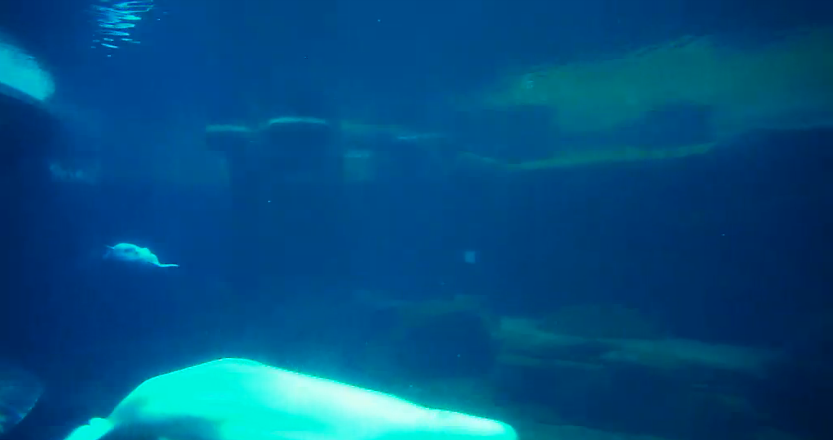
Here's an example of Nemo using his tail to propel himself forward in the water.


Tuesday, October 7, 2014

Concerning Belugas: "Boring" traits, that are kind of interesting to know about

10:24 AM
Quick facts about "White Whales"

Life span (of wild Belugas): 35-50 years
Length: 4-6 meters
Weight:  1-1.5 tons
IUCN rating: "Near Threatened"
Sexual Maturity: Males at 8-9 years of age, females 4-7
Group: Live in pods
Where: usually occupy Arctic waters
Why are they threatened: trapped whales, are often hunted by indigenous people of the North, Polar bears and Killer whales
Related to: The NARWALS
Food: usually prey on crustaceans, fish, and bottom feeding worms.

labeled for reuse

Thursday, July 31, 2014

Concerning Belugas: Meet Captain Nemo and Wake

8:27 PM
Beluga Webcam, courtesy of Vancouver Aquarium

Disclaimer: Any images, unless otherwise specified, are screenshots that I've taken from the above linked webcam.


The webcam that I am currently spending hours ogling over is provided by Vancouver Aquarium: specifically, the Beluga Whale cam. Belugas are an animal that I know little about, and indeed have spent little time thinking about them. At least partially, this is due to lack of coverage: I don't think I've ever come across an article about a Beluga. Only as of about 1 minute ago do I know that Belugas are classified as "near threatened" according to the IUCN Red List: this is largely due to the minor, but continued practice of Beluga Whale consumption.

I think my complete ignorance on this species is one of the reasons why I decided to observe these animals. Having a great love for the oceans and it inhabitants I make it my mission to know as much as I can about them, and when I saw a link to a Beluga webcam I couldn't resist. And so here we are.

My previous (and first) post, recording, what is probably just incoherent ramblings of a mesmerised, wannabe scientist is just that: a bullet point list of random observations. Later on I will see what I can do to analyse some of those behaviours, however, for today I wanted to introduce myself to the aquariums inhabitants.

The whales seem to be taking turns appearing in the scope of the camera, however, a few times (as pictures here) they can be seen together. Belugas are incredibly social animals, travelling in small pods, as many whales practice; they are known as being incredibly vocal, although unfortunately their is no audio feature in this footage.


Very early on I was exposed to what I've learned is a typical behaviour: swimming upside down. Although, I haven't researched this behaviour as of yet, I will be sure to do so. What I've noticed is that when swimming as pictured to the right the whales neglect using their head. When they are swimming the 'correct' way they move their heads up and down- suggesting that this helps to propel them forward. I think my assumption is furthered by the fact that the whales appear to move much quicker when upright. So with my very limited knowledge about this animal I believe that while swimming 'normally' allows them to move at greater speeds, swimming 'abnormally' allows them to save energy. However, the thing I wanted to discuss was what I noticed on one of the whales, that has developed into its distinguishing factor. When swimming upside down I noticed an odd indentation near the base of one of the whale's tails. I waited (for quite a long period of time) until I saw both of the whales at once, so that I could confirm that this indentation wasn't a normal characteristic for belugas. When seen from a side angle the formation looks something like the number eight.


Although on closer inspection it looks more like a circular indentation with two linear indents leading off of it. Anyway, I'm not entirely certain what this formation is, whether it's natural, or obtained sometime during this animal's life, nonetheless, it helps me to distinguish this animal from the other. I've taken to calling this Beluga, Captain Nemo, after the character in 20,000 Leagues Under the Sea (one of my favourites).

I was quite pleased with myself for having found a way to distinguish the two animals until I realised that it was useless unless Captain Nemo happened to rotate his body. So it was back to the drawing board for me. Until I observed another oddly shaped formation on one of the whales'  bodies: on either side of it ridge like structures could be seen jutting out of the main tail. It was only until I was able to see these structures on the whale then witness it turning that I could confirm that those ridges made up the figure eight I'd spotted earlier.

Unfortunately, I've been unable to find a distinguishing feature on the remaining Beluga, although I'm still hopeful to spot something. I've taken to calling this elusive Beluga, Wake.

That's it for today!

Saturday, June 28, 2014

Concerning Belugas: The Tank that Never Sleeps

9:56 PM
Beluga Webcam, courtesy of Vancouver Aquarium

Disclaimer: Any images, unless otherwise specified, are screenshots that I've taken from the above linked webcam.


When I logged on to pay a visit to Wake and Nemo today, I first thought the webcam wasn't working, or was offline. Until I saw the above image. Turns out Captain Nemo doesn't stop his circuit- even to sleep.

1. It's a little difficult to see, however, this is evidently Nemo. You can see the slight ridges on the tail.
As you can see Nemo is on the first leg of his circuit in this image, swimming upside down towards the boulders.


Another circuit run


Here's Nemo a little later on.
It's a little brighter, and thus you can start to see the boulders and Nemo swimming his usual circuit.


The second part of Nemo's journey.
The tank was too dark to see the turn around the boulder.
He's now upright and swimming offscreen.


Wake's on the move.
Unlike Nemo, I've seen Wake swim towards the camera a number of times.
Although, he too, rarely swims the opposite direction.


Wake's saying hi to the camera


Saw odd behaviour where Wake was rolling in the water in this location.


Nemo blowing bubbles on the surface of the water
He seems to be breathing in addition to this new bubble blowing behaviour.


Bubble behaviour.

Close up of Captain Nemo turning around the boulder.


Concerning Belugas: Breaking the Circuit (Wake)

2:35 PM
Beluga Webcam, courtesy of Vancouver Aquarium

Disclaimer: Any images, unless otherwise specified, are screenshots that I've taken from the above linked webcam.


Wake has been somewhat of a mystery to me: whereas Nemo has been very forthcoming with his appearance, Wake only appears on occasion.

Today I was actually trying to observe Nemo's obsessive circuit swimming, as is such I had the webcam running in the background, as luck would have the next time a glanced at the screen I saw two Belugas.


Wake had decided to make an appearance. 

Before I continue I wish to clarify something: as I am unaware of the gender of the Belugas I'm going to refer to them as both male. I realize the unlikelihood of this suggestion, but bear with me. The sole reason for this is to relieve me of the hassle of writing "he/she". 

Anyway, the first thing I noticed was, a lack of circuiting: which I do believe is a good thing. However, after observing Wake for a longer period of time I did start to notice some repitious behavior: nowhere near as obsessive as Nemo however. 

Wake always seems to stop for air in the far left corner. Not only that that location seems to be his base for odd behaviour.

Nemo is on the right Wake is on the left
Wake (when he's around) frequently occupies the far left corner.
I noticed that he does a weird shimmy on occasion. The best way I describe it is a sort of wiggle. He begins by swimming towards the ground (holding is body vertically), then returns to the surface.


Often after the shimmying behaviour Wake spends a large amount of time with his head exposed to the surface.
At first I thought he might be getting fed, however, that would beg the question why Nemo is never exhibiting this unusual behaviour.
He often stays in this vertical position for a good 20 seconds.


Wake doesn't seem to be duplicating Nemo's circuit, as is shown here. Wake is swimming back to the invisible part of the exhibit while on his side. I haven't seen this behaviour with Nemo. Nemo, only swims while on his side when turning around, whereas Wake seems to do this for greater distances.


Another example of Wake's odd shimmying behaviour.
The motion is almost comparable to that of a snake, just in water.
I will have to do further research on this behaviour later.


Downward swimming.
The odd thing is that there doesn't seem to be anything down there- least of all food. Thus making me wonder if this is another form of obsessive swimming.
This is the first step in Wake's shimmy.


Image of the odd lengths of time spent with his head exposed to the surface.


The two Belugas don't seem to interact with one another, although Belugas are known to be large vocal communicators, and unfortunately there is no sound capabilities on this webcam.
Nemo is on the left, running through his circuit.
Wake is towards the right.


Wake's shimmying behaviour.
Although, he moves when running through this behaviour it is hardly a useful propulsionary tool.
My best guess is it's another version of a obsessive compulsive disorder.


Wake, granted rarely, sometimes swim against the 'gradient' circuit.
Whereas, Nemo has, as far as I've seen, never swum in the opposite direction.


Friday, June 27, 2014

Concerning Belugas: Swimming the Circuit (Captain Nemo)

4:31 PM
Beluga Webcam, courtesy of Vancouver Aquarium

Disclaimer: Any images, unless otherwise specified, are screenshots that I've taken from the above linked webcam.


I've already expressed my concerns regarding captivity of orcas and dolphins: largely due to their confirmedly high levels of intelligence, particularly social. Wake and Nemo are both captive Belugas, and I think Nemo may be demonstrating some tendencies associated with captivity- I will look in to the research at a later date.

There are many reports concerning boredom in captive animals, and the many habits that may accompany the feeling. Although, from what I can tell the tank is sufficiently large, especially considering the number of animals in it (2 as far as I can tell), Nemo is clearly showing signs of 'pacing'. I'm not certain of the technical term, however, Nemo is showing a consistent pattern of movement. For the past 35min. Nemo has relentlessly swum the same circuit, coming up to breath on average every 2-3 completed circuits.

1. As you can see, this particular animal is Nemo (I discussed on the last post the ridges on his/her tail can be seen from the sides, that make up a unique pattern when turned). Nemo begins the circuit by entering upside down. He/She always enters from this point


2. It's hard to see on this image...
Nemo continues to swim upside down heading towards the boulder like structure near the far end of the exhibit (better view of the structure on the previous image). Nemo's head hardly moves when upside down.


3. Better to see the exact positioning on this image (screenshot).
As you can see, Nemo goes far into the left corner.


4. Once Nemo reaches the end of the tank he turns on his side (exposing his tell-tale indentations).
He usually starts to turn when he's a meter or so behind the boulder.


5. Nemo then disappears behind the boulder and when he appears again, he's righted himself.
The times that I've observed him he's always swum in-between the two boulders.


6. Nemo continues on his upright journey.


7a. Nemo swims upright until he disappears from view, and when he appears, usually 5-10 seconds later, he is upside down again. And the process repeats itself.


Or 7b. Every 2-3 completed circuits when completing his circuit, Nemo pushes his head up to catch a breath, before disappearing.


Thursday, June 26, 2014

Concerning Belugas: Initial Observations

8:05 PM
Beluga Webcam

Disclaimer: If otherwise unspecified in this particular piece the images are screen shots from the aforementioned webcam.

16:40
Large vertical ledges in centre of the aquarium
Two animals are to be seen
Both are swimming with their back towards the ground and their belly towards the sky (upside down)
When turning move body to the side
When swimming in a straight line the first half of the body is kept still while their powerful tails periodically move vertically (slicing through the water)
When swimming with their backs towards the sky the head moves with the motion of the tail
Pectoral fins don't seem to be used

16:44
Both belugas have righted themselves and are swimming with their bodies' slightly out of the water, probably getting oxygen
Dove head first back into the depths of the pool
One is going through a series of curls bending itself into a coil then righting itself again
That same Beluga swam into a small indent in the wall upright, then flipped during the turn then swam upside down again

16:46
One of the belugas is near the surface again


That same beluga has returned to the depths and has swum at a higher speed while on its side
One of the belugas is swimming upright again and the head seems to be used when in this position to further propel the animal forward

One of the belugas has an 8 shaped indent near the start of its tail (Captain Nemo)

16:51
Captain Nemo swam with body held at a 90 degree angle when swimming around a boulder
Nemo swam upside down then swiftly righted him/herself to break the surface of the water again.
Swimming upside down appears to require less energy as they swim in this method more frequently in this particular environment and they aren't moving their had as they do when swimming with belly down

16:54
One of the belugas righted itself to an upright position and shimmied itself up.

Wednesday, June 18, 2014

Concerning Puffins: Initial Observations

9:35 PM
Atlantic Puffin Webcam Stream
Disclaimer: If otherwise unspecified in this particular piece the images are screen shots from the aforementioned webcam.

21:20
Resting on cliffs
The rock appears to be smooth with little in terms of dangerous edges
Currently 11 birds on the visible area
Half the group was resting- body held low against the rock, neck pushed up against back
Resting birds close eyes for longer periods of time, still periodically blink
Half the group is moving around, one bird at edge of cliff moving head methodically from side to side (perhaps keeping watch)
Birds can be seen flying near the cliffs, perhaps trying to find food
No visible eggs- appears to be a resting place
Birds can be seen ruffing up feathers then folding them back up
One bird observed tending to feathers near breast bone

21:23
All of visible group lying down excluding one
The others have rapidly stood up and began walking around
Observed ruffling wings then folding them back together once standing up again
When ruffling feathers observed doing a slight jump
The head is the last to shake after the ruffling of feathers through the shaking of the wings
When shaking wings fly a very short distance
Frequently shake wings then fold them back up
Seem to take turns lying down for brief periods then standing up again


21:26
At times many of them seem to be lying down at a time with one or two lookouts
Others most are standing
Two birds are making noises at one another while facing each other
The beaks are opened and showed to the other bird
Seems to be either courting behaviour or rivalry
One of the birds has laid down and the other does a few more head motions and walks off
Most are standing again

21:28
Have now noticed during shaking of feathers the chest of the bird is slightly extended outwards as the back pushes inwards causing the bird to further right itself
The shaking of the wings seems to be used both for brief transportation and/or tending of the feather
Perhaps this helps to dry the feathers quicker
Molting?

21:30
When walking the birds use quick movements with their legs
They are in an upright position while walking although their bodies' are at a noticeable tilt

21:31
A huddle of 6 birds can be seen at the edge of the cliffs
They seem to be communicating with one another
The group has quickly broken up and the group has dispersed

21:32
Some birds seem to hold their body in a more upright (proud?) position than others
Is this a sign of rank?
One bird can be seen pecking another bird

21:33
A large group of arctic terns can be seen flying directly over the puffin colony
All of them are now standing
Many are shaking their wings (more then before)
Perhaps also a defence mechanism? Makes them seem larger than they are

Summary: These birds are not particularly vocal. The vertical movement of the wings appears to play one if not several important roles in the puffins' behavior: upkeep of their feathers, defensive strategy against possible predators, brief transportation. They seem to have a form of hierarchy in the posture of some of the birds: whilst some of the puffins stand straight others adopt a more slouched position. Finally, competition between the puffins is kept at a respectable level: the wings of the two participants are held at slight angles whilst the chest is pushed out wards, the birds call while presenting their exposed mouth at their opponent. Following this procedure the supposed winner of the match walks off, still mouth agape, while the defeated lies down. However, I could be mistaken: if the competition was for a roosting place the winner may well be the one who settles on the ground.